Going Dark Like the Weather Underground

I bet y’all thought I had done gone dark on you. Like the Weather Underground. Forget seen but not heard, not seen nor heard. Truth is, I have been busier than a one-legged man in an ass kicking contest. VA has had us spread thinner than a stick of butter on a hot summer day. I have not wrote in a while because of all that has been going on at VA. The new name of the game is fast, not right, just fast. We have gotten 22 BVA decisions this month. We have been getting about 18 to 20 supplemental claim or higher-level review decisions a week on top of that. I had to file two suits against ole Doug Collins this month, with more incoming, wink wink.
That’s not me whining and moaning about being busy. Lord knows there is always work to do when you stand beside Veterans (versus kicking them while down). I am telling you because the pile tells a story. And it is a story VA needs to hear. Somewhere along the way, somebody decided that the scoreboard mattered more than the ballgame. Get the decision out. Clear the queue. Move the widget. Make the chart look pretty. Get on TV. Tell the cameras. Tell Congress. Look, what backlog? Then call it a victory.
Well, I reckon a fast wrong decision is not progress. It is just another obstacle a Veteran has to fight through. More delays. More Veterans die without benefits because they were denied instead of getting it right the first time. Again, hey, no backlog, though. Veteran’s don’t experience a bad decision as a number on a Monday morning report. Veterans experience themat the kitchen table, trying to explain to a spouse why the money still is not there. They just don’t get it. I have been to 6 exams already. They experience it sitting in the parking lot after C&P, wondering whether anybody at VA actually read the record. They experience it when a claim that should have been decided right the first time gets kicked down the road for another review, another exam, another stack of forms, and another season of waiting.
That is the part folks in the ivory tower forget. Every decision has a name on it. Every file belongs to a person. Every mistake has a cost. But, when you are just focused on production, who gives a damn?
Fast Is Fine. Right Is Required.
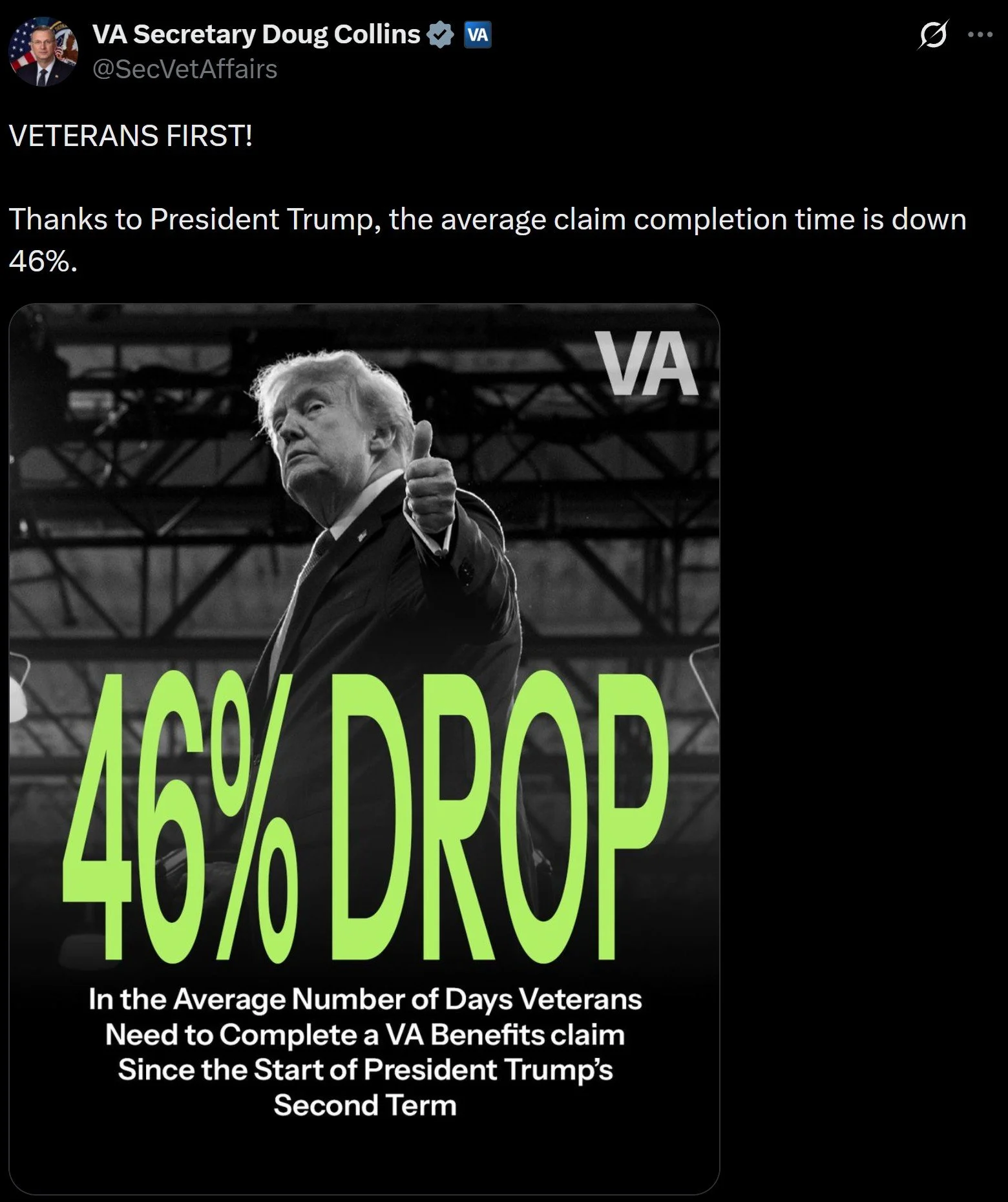
Bless their hearts, the scoreboard does look better. NOTUS reported that VA’s backlog, which VA defines as claims pending at least 125 days, has fallen to about 70,000 from more than 400,000 in March 2024. That is a number worth noticing. Veterans should not have to wait around for a claim to ripen like a green tomato on the windowsill.
But here is the prickly pear. A lower backlog is not the same thing as a better benefits system. NOTUS also reported that VA completed nearly 30,000 more claims in the last three months of 2025 than it did in the same period two years before, but granted 9,000 fewer. Hmm. The reported denial rate climbed from 35 percent in fiscal year 2024 to 38 percent in fiscal year 2025, then to 39 percent in the first quarter of fiscal year 2026. That ought to make every Veteran and every advocate sit up a little straighter.
Now, don’t misunderstand me. Nobody is asking VA to move slow just for the pleasure of it. Veterans have waited long enough already. There is no prize for letting a claim collect dust like that old car you got put up on cinderblocks in the front yard.
But speed without accuracy is just a revolving door, and that is all the VA claim system has become these days.
If VA rushes out a decision that ignores favorable evidence, misses the actual issue, leans on an examination that does not answer the question, or treats a Veteran like a file number instead of a human being, then VA has not solved anything. It has simply transferred the work to the Veteran, the Veteran’s family, an advocate, a judge, or whoever has to clean up the mess next.
That is why this flood of decisions has us running hard. The sheer volume is not the whole problem. A lot of Veterans would be happy to see a decision arrive sooner rather than later. The problem is when the pressure to close cases turns decision makers into folks working a drive through window. Push it through, hand it out, and hope nobody notices what is missing from the bag. What side of ketchup (i.e., missing SMC). What side of fries (i.e., the effective date is all jacked up).
Veterans notice. Their families notice. And people like me notice.
NOTUS reported that higher level-reviews have doubled since the Collins administration. That ain’t a victory lap. That is a blinking warning light on the dashboard. A higher level-review is supposed to be a Veteran’s chance to have a more senior reviewer catch an error based on the evidence already in the file. If the number is shooting up, somebody ought to be asking why so many Veterans need a second set of eyes in the first place.
But wait, VA says its accuracy data are improving. A VA spokesperson told NOTUS that its public data show roughly 83 percent of claims are error free, up from roughly 79 percent when the backlog peaked in 2024. VA also says those figures come from a statistically significant random sample. There just ain’t no way. When a Veteran has to file a supplemental claim because the first decision got it wrong, that is not efficiency. When a Veteran has to request higher-level review because somebody overlooked the law or the evidence, that is not customer service. When a case lands at the Board because VA could not get the basics right down below, that is not a success story. That is a system charging Veterans interest on an error it made itself.
Or, you could be like one of my clients. We have been trying to get his knee ratings right this whole year. Eight, yes eight, decisions this year, just on the knees, every one of them screwed up six ways to Sunday.
Freedom 250
Oh God the irony. Now let us talk about Freedom 250, because the documents VA released through FOIA tell a fuller story than a neat little announcement about reducing the backlog. Freedom 250 was built around America’s 250th birthday. VBA set three challenges to be achieved by June 30, 2026: get the disability backlog down to 64,782 claims or fewer, help 9,050 Veterans achieve Veteran Readiness and Employment positive outcomes, and hire 328 Veteran Readiness and Employment employees. On paper, two of those goals are plainly good things: more Veterans succeeding in employment or independent living, and more counselors and specialists to reduce caseloads. Nobody ought to fuss with that. The question is what happened when the claims backlog goal became the headline prize.
That number was not picked out of a hat. The FOIA production shows VA had previously reached a low of 64,783 claims during President Trump’s first term. Freedom 250 aimed to beat it by exactly one claim. One less claim than the old record. That is the kind of target that makes a good press release, but it also tells you what (and why) management was watching mighty close.
The documents also show this was not just a quiet internal goal. VBA staff were planning the “communications engine” around the milestone. A message after the achievement, discussion of the other goals, possible regional-office celebrations, recognition for stations with the most backlog completions, and a July Fourth press release highlighting “best ever” and similar accomplishments. One internal email candidly described the goal as achieving the record and then “bounce back to a steady state above that record level.”
And yes, there was a reward attached. The initial all-employee message said eligible employees would receive 10 days of telework if their particular goal was achieved by June 30, 2026. A later March update changed the recognition. If VBA successfully met the Freedom 250 goals by June 30, eligible employees would receive eight hours of time off. So, let us keep the facts straight. The FOIA records show that the original proposal promised ten telework days tied to each achievement; the later update promised one paid day off tied to meeting the full set of goals.
Now, I do not begrudge anybody a day off. Lord knows the people doing this work carry a heavy load, and plenty of them are trying their best inside a system that keeps changing the rules and squeezing the clock. A person processing claims did not create the backlog alone, and that person should not bear all the blame when the system gets it wrong.
But when the reward, the milestone, the recognition, and the communications plan all revolve around making the pile disappear by a date certain, you had better be mighty careful what lesson you are teaching. You cannot pay people to make the hay disappear from the barn and then act surprised when somebody quits checking whether the horses are still in there.
The incentive should be getting the claim right. It should be catching favorable evidence, asking a medical examiner the question that actually needs answering, and giving a Veteran a decision that does not have to make a round trip through higher-level review, a supplemental claim, the Board, or a courtroom. If production goals are part of the equation, then quality control has to be written in letters just as big.
Because a paid day off is a fine thing. But it is a poor trade for a Veteran who gets an extra year or two of fighting a bad decision.
The Quiet Part Out Loud
There is another reason I have been hard to find lately. Sometimes you have to quit standing on the porch and walk down to the courthouse. When VA will not answer straight, when it will not follow the rules, when it acts like a Veteran ought to be grateful for a half answer or no answer at all, there are times when a polite letter will not do the job. There are times when you have to put the issue in front of somebody with a robe and a seal and ask them to make VA explain itself.
That is what lawsuits are for. They are not a hobby. They are not a publicity stunt. They are what folks use when the ordinary channels are clogged up, shut down, or being treated like a suggestion.
I wish every problem could be fixed with a phone call and a reasonable person on the other end. Bless their hearts, there are still plenty of good people at VA trying to do right by Veterans. But a good person working inside a bad process can only do so much. If the process rewards fast over right, then it will keep producing decisions that look good on a spreadsheet and feel awful in real life.
The answer is not to slow everything to a crawl. The answer is to make accuracy count again. Read the record. Ask the right medical question. Explain the decision in plain English. Correct an error before making a Veteran prove the same point for the third time. And when VA does get it wrong, own it quick and fix it quicker.
The warning signs are not just coming from outside the building. Back to the NOTUS report. NOTUS reported that about 97 percent of Board attorneys surveyed believed new quotas made factual or legal errors more likely, and 93 percent said they no longer had time for a completely fresh review. An inspector general official also told NOTUS that the system had become so production oriented that it was “at the expense of quality.” If the folks reading the files are telling us the line is moving too fast, it might be time for somebody to quit hollering “faster” and start asking whether the wheels are coming off.
Secretary Collins has said the department is committed to “faster decisions, better service and more benefits.” I am for every bit of that. But those words have to travel together. Faster decisions without better service are just quicker disappointments. And more decisions without decisions that hold up are just more work waiting on the other side. That would save time. That would save money. Most importantly, it would save Veterans from carrying a burden that never should have been put on their backs.
So no, I have not gone dark. I have been right here, elbows deep in decisions, records, appeals, and court papers, trying to make sure Veterans do not get steamrolled because somebody wanted a better monthly number.
We will keep reading every page. We will keep calling out the nonsense. We will keep filing what needs filing. And when VA mistakes speed for justice, we will remind them that Veterans did not serve this country so they could spend the rest of their lives fighting an assembly line.
VA can move fast. I am all for it. But it had better be right.
Because a decision made right the first time is not just faster in the long run. It is the least VA owes the people who already gave this country more than most folks will ever understand.
And if that message takes a few more filings, a few more lawsuits, and a few more long nights with coffee gone cold on the desk, well, I reckon we know how to do that too.